Asia is experiencing the profound effects of climate change. According to the State of the Climate in Asia 2023 report from the World Meteorological Organization, Asia is the region most affected by weather, climate and water-related hazards. This underscores the urgent need to accelerate adaptation, mitigation and investment in resilient infrastructure.
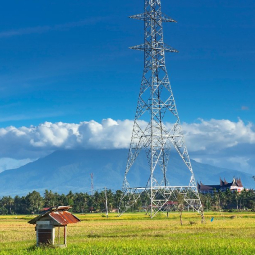
As a multilateral development bank, AIIB integrates climate considerations across everything we do: scaling sustainable infrastructure, greening cross-border connectivity, mobilizing private capital at pace, and deploying technology-enabled solutions that reduce emissions and strengthen resilience.
From clean energy and smarter cities to nature-positive investments and climate adaptation, AIIB partners with a wide network of partners, including multilateral and national development banks, bilateral development finance institutions, philanthropic organizations, multilateral funds/platforms, technical assistance partners, knowledge partners, and global and regional platforms. By mobilizing our capital, capacity and convening power, we help our Members transform their climate commitments into bankable projects that improve lives today and for generations to come.
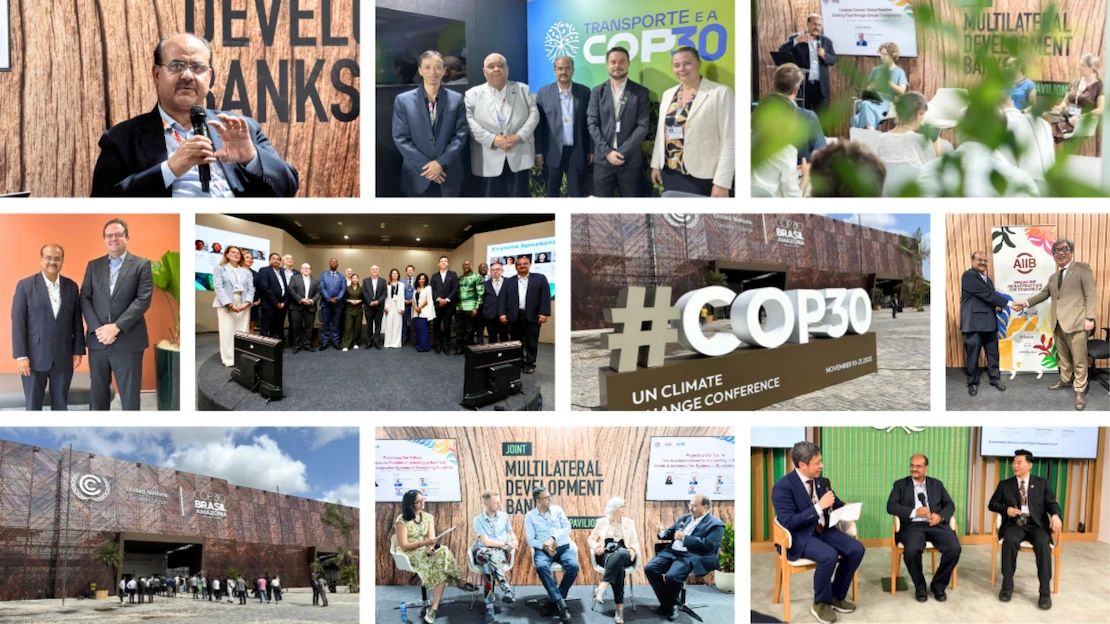
AIIB participated in COP30 in Belem, Brazil, with a delegation led by Vice President Investment Solutions Ajay Bhusan Pandey, Chief Economist Erik Berglof, and General Counsel Alberto Ninio. The delegation engaged government leaders, peer multilateral development banks (MDBs), and private sector partners to advance the ‘Amazon COP’ agenda. Anchored at the Joint MDB Pavilion, the Bank’s presence focused on scaling nature-positive infrastructure and integrating health into climate resilience.
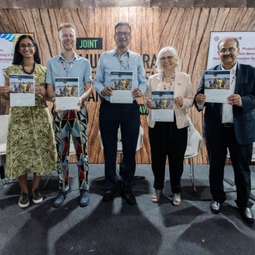
The Bank showcased its evolving climate mandate through high-level and technical sessions on biodiversity, health, and adaptation. These included the launch of two landmark reports: one with Gavi on the climate resilience benefits of immunization, and another with EBRD and the Paulson Institute on integrating nature into infrastructure planning and mobilizing private capital. AIIB also highlighted its ‘Nature as Infrastructure’ approach and convened strategic dialogues on blended finance and the ‘Baku to Belem Roadmap’ to mobilize capital for emerging economies and integrate natural capital into development planning.
Substantive outcomes underscored AIIB's commitment to the host region and global resilience, including the approval of a USD1-billion climate-focused policy-based loan for Brazil’s Ecological Transformation Plan. Additionally, AIIB joined peer MDBs in a ‘Call to Action’ to scale nature finance and adopted common principles for tracking nature-positive investments, reinforcing the Bank's operational momentum and commitment to Paris-aligned, country-driven solutions.
READ MOREAIIB participated in COP29 in Baku, Azerbaijan with a 29-member delegation from 10 departments led by President Jin. Under the Presidency’s theme “In Solidarity for a Green World,” the Bank advanced its climate mandate through 13 high-level and 22 technical engagements. These included a UNFCCC side event on integrating health, air quality, climate, and nature into infrastructure finance, as well as four AIIB-led sessions at the Joint MDB Pavilion on planetary health, innovative climate financing partnerships, independent evaluation, and scaling adaptation. Senior management also held targeted bilateral meetings with national authorities and institutional partners to advance country-led initiatives and project pipeline development.
Substantive outcomes were achieved. AIIB contributed to the Joint MDB Statement on Climate Finance, which projects by 2030 an annual collective USD120 billion for low- and middle-income countries – including USD42 billion for adaptation – and aims to mobilize USD65 billion from the private sector. The Bank also endorsed three COP29 Presidency declarations: the Baku Initiative on Human Development for Climate Resilience; the Green Energy Pledge on Green Energy Zones and Corridors; and COP29 Green Digital Action. In addition, the Bank aligned on a COP29-to-COP30 roadmap to sustain momentum on country platforms, harmonized metrics, and private-capital mobilization.
AIIB further strengthened partnerships and delivered concrete financing steps. The Bank renewed its MOU with the Asian Development Bank, signed a Letter of Intent with the Global Center on Adaptation, and advanced project-level agreements with Masdar and two Azerbaijan projects. Together with ADB and the European Bank for Reconstruction and Development, AIIB signed finance documents for the 760 MW Banka and Bilasuvar solar PV plants, sponsored by Masdar and SOCAR Green. These projects are expected to avoid approximately 725,000 tonnes of CO₂ annually and triple Azerbaijan’s solar capacity.
Through these engagements, AIIB reinforced its multilateral role and operational focus on scalable, country-driven climate solutions in Asia and beyond.
READ MOREAIIB participated in COP28 in Dubai to advance its climate mandate and strengthen its multilateral engagement. The Bank’s presence was anchored by its first standalone pavilion in the MDB Blue Zone and supported by a 48-member, 11-department delegation. Through 28 AIIB-hosted sessions, including five flagship events, and joint programming with partners such as the United Nations Development Programme (UNDP), the OPEC Fund for International Development, the International Union for Conservation of Nature and GEAPP, AIIB showcased its Climate Action Plan, Asian Infrastructure Finance research, and initiatives on Infratech, mitigation and adaptation, capital markets and urban resilience. Senior leadership also contributed to COP28 and UNFCCC platforms alongside peer MDBs, reinforcing AIIB’s commitment to country-led approaches and enhanced MDB coordination.
COP28 delivered concrete institutional outcomes. AIIB formalized cooperation through memoranda and letters with the Food and Agriculture Organization, UNDP, the United Nations Industrial Development Organization, FONPLATA, the OPEC Fund, ADGM and the United Nations Department of Safety and Security; strengthened collaboration on country-sector platforms; and contributed to joint MDB initiatives on ISSB-aligned sustainability disclosure and tracking nature-positive finance. These engagements underscore AIIB’s continued focus on scaling climate finance across Asia and beyond and its alignment of all financing operations with the Paris Agreement since July 1, 2023.
READ MOREAIIB participated in COP27 in Sharm el-Sheikh, Egypt with a focused delegation that engaged governments, peer multilateral development banks (MDBs), private sector leaders, and international institutions across high-level events and technical sessions. The Bank advanced core messages on mobilizing finance and technology to address climate change, and on scaling adaptation and resilience, including via capital markets, through AIIB-led events and contributions to platforms on green hydrogen, smart connectivity, debt and renewable energy, Paris alignment, net zero, and the United Nations Framework Convention on Climate Change (UNFCCC) Global Innovation Hub.
AIIB paired its messages with concrete actions and commitments. The Bank announced a 2023 resilience bond and expressed interest in implementing climate-resilient debt clauses; joined strategic partnerships such as the Global Energy Alliance for People and Planet (GEAPP) and Energy Transition Accelerator Financing Platform; and engaged initiatives including the Coalition for Climate Resilient Investment to enhance climate-risk pricing and catalyze adaptation finance. These steps reinforced AIIB’s progress toward Paris alignment, expanded climate finance, and strengthened private-capital mobilization through innovative structures and partnerships.
Negotiations in parallel culminated in the Sharm el-Sheikh Implementation Plan, which included agreement to establish funding arrangements for loss and damage. The cover decision also called on MDBs and international financial institutions to reform their practices, scale and align funding, and expand the use of grants, guarantees, and non-debt instruments to enhance ambition – particularly through private-capital mobilization and more effective use of concessional and risk capital. It further invited support for the UN’s Early Warnings for All initiative.
For AIIB, these outcomes underscore the mandate to deepen Paris alignment, increase climate finance, diversify financial instruments, and strengthen country-driven resilience solutions.
READ MOREAIIB participated in COP26 in Glasgow, marking the Bank’s first official attendance at the Conference of the Parties. A delegation led by former Vice President Danny Alexander engaged with peer multilateral development banks, government stakeholders, and private-sector partners to communicate the Bank’s green credentials and its vision for supporting clients in the transition to a low-carbon economy.
The Bank showcased its initiatives aimed at accelerating the transition to low-carbon economies, including investments in renewable energy and climate-resilient infrastructure. AIIB also highlighted its collaboration with international partners to catalyze private capital and enhance the effectiveness of climate action.
AIIB anchored its presence with a historic institutional commitment: the Bank announced it would align all new financing operations with the goals of the Paris Agreement by July 1, 2023. This milestone reinforced the Bank’s targets to achieve a 50% share of climate finance in actual financing approvals by 2025, and to reach cumulative climate finance approvals of USD50 billion by 2030.
READ MORE
India: Andhra Pradesh Rural Roads
In the heart of rural Andhra Pradesh, new all-weather roads are transforming daily life. For teacher Sujatha Sooram and her pupils, these roads mean safe, reliable access to education—rain or shine. As climate extremes threaten rural livelihoods, this AIIB-financed initiative is more than infrastructure; it’s a bridge to opportunity, resilience and hope for millions navigating the realities of a changing climate.
READ MOREIndonesia: Strategic Irrigation Modernization and Urgent Rehabilitation Project
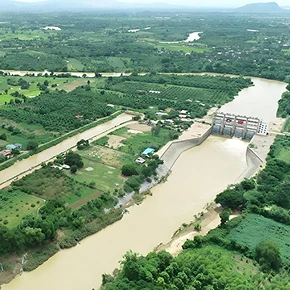
For rice farmer Kendo in West Java, water is everything. Damaged canals and unpredictable rains once made harvests uncertain. Now, an AIIB-financed irrigation modernization project ensures equitable water distribution, automated scheduling and climate-resilient farming. As Indonesia faces intensifying droughts and floods, these upgrades are safeguarding food security and rural livelihoods—ensuring that families can weather the changing climate, one rice field at a time.
READ MOREUzbekistan: Bukhara Region Water Supply and Sewerage (BRWSSP)
In arid Bukhara, new AIIB investments are delivering safe piped water and modern sewerage to thousands of homes. For families—especially women and girls—this means better health, dignity, and time saved. Smart meters and leak detection systems are helping conserve water, strengthening climate resilience in one of the world’s most water-stressed regions.
READ MOREDesigned to guide AIIB’s climate ambition from 2024-2030, the Climate Action Plan brings together the principles governing the Bank’s climate financing while identifying crucial action areas that will steer AIIB’s investments in support of its Members. The document is a statement of intent to AIIB’s Members and partners.
READ MORE
China: Henan Flood Emergency Rehabilitation and Recovery Project
In July 2021, record-breaking rains in Henan turned lives upside down—14.8 million people across 150 cities were affected as floods swept through homes and communities. Families faced unimaginable loss, with hundreds of lives claimed and billions in damages.
China: Henan Flood Emergency Rehabilitation and Recovery Project
After floods devastated Henan, a USD1billion loan from the Asian Infrastructure Investment Bank (AIIB) helped finance the recovery project, which is rebuilding not just infrastructure, but resilience—integrating climate-adaptive design, digital flood-management systems and nature-based solutions.
China: Henan Flood Emergency Rehabilitation and Recovery Project
For the people of Zhengzhou, Xinxiang, and Jiaozuo, this meant safer cities, stronger preparedness and a future where communities can withstand the storms ahead.
READ MORE
In 2017, a landslide in Sri Lanka swept away many homes, destroying livelihoods, temples and properties down the way.
After the landslide swept away her home and livelihood, Manori Manorathna and her brother M.A. Gnanassena lived in fear of every rainstorm in Sri Lanka’s highlands.
Sri Lanka: Reduction of Landslide Vulnerability by Mitigation Measures Project
Today, a new landslide mitigation project financed by AIIB offers renewed hope—protecting families, preserving ancient temples and supporting local economies. Niranjan Jayakody, believes that as climate change brings heavier monsoons and greater risks, these efforts help communities reclaim their land and rebuild their future, transforming vulnerability into resilience.
READ MORE