
Central Asia stands at a pivotal juncture in its economic and infrastructure development. After decades shaped by legacy transport links and fragmented national systems, the region is emerging as a strategic crossroads between Europe and Asia. Renewed interest in alternative trade routes – notably the Trans-Caspian International Transport Route via the South Caucasus and Türkiye – reflects shifting trade patterns, a more complex geopolitical landscape and deeper regional cooperation.
The Asian Infrastructure Investment Bank (AIIB), the Islamic Development Bank (IsDB) and the Multilateral Cooperation Center for Development Finance (MCDF) jointly conducted a diagnostic assessment of Central Asia’s cross-border connectivity, covering transport, power and digital connectivity. Through several consultations with governments and development partners in the region, the three parties took stock of the current regional infrastructure landscape and discussed priority areas for coordinated policy reform and targeted investment to enhance connectivity and enable long-term financing.
Central Asia’s connectivity landscape is characterized by tangible progress and persistent structural challenges.
Several national development strategies explicitly position connectivity as a driver of economic diversification and competitiveness. Accordingly, governments across the region have made significant investments in roads, railways, energy networks and digital infrastructure.
Yet performance and implementation remain uneven. Infrastructure quality, institutional capacity and access to finance vary across economies and sectors. While some economies have emerged as regional infrastructure anchors, others struggle with aging assets, limited multimodal integration and fragmented planning and delivery. Deeper coordination and more deliberate sequencing of investments in the region are needed to shift from project-by-project investments to a more collective, strategic framework for cross-border connectivity.
The most compelling finding from our assessment is that coordinated, programmatic investment can unlock far greater value than isolated interventions. Connectivity should not be viewed as an end in itself but as an economic multiplier that drives trade, competitiveness and inclusive growth in Central Asia.
Evolving trade patterns and alternative corridors are creating new opportunities to serve both intercontinental transit and growing intraregional trade. Investments that reduce bottlenecks or enhance multimodal integration can lower costs and improve reliability. These gains translate to transit revenues and also directly support domestic producers and regional value chains.
In the energy sector, stronger cross-border interconnections and gradual market integration can improve asset utilization and enhance system resilience. That would be in line with global decarbonization objectives and climate finance priorities. Improvements in data infrastructure and digital platforms can enhance the performance of physical networks, while the digitalization of border management, logistics and energy systems can reduce transaction costs and enable new services and business models. Similarly, citizen access to digital services can unlock new economic opportunities.
Overall, clearer national strategies, enhanced regional cooperation and increased engagement from development partners have improved investment visibility and readiness. More of that will enable infrastructure banks and long-term investors to deploy capital at scale and with confidence to achieve measurable impacts.
At the policy level, a viable regional connectivity agenda requires closer alignment of national strategies with regional objectives. This includes harmonizing technical standards, streamlining border and regulatory procedures and embedding digital solutions into infrastructure planning from the outset.
Equally critical is strengthening institutions responsible for planning and project preparation. These capabilities underpin the ability to translate strategic intent into bankable projects.
Bundling projects across corridors or sectors, sequencing investments based on long-term returns, and linking physical assets with “soft” measures such as regulatory reform and capacity building can significantly improve risk profiles and development outcomes as well as attracting private capital.
Multilateral development banks are well positioned to act as conveners and standard setters, helping economies align investments with long-term regional goals and crowd in private investors. Accordingly, AIIB has invested in projects aimed at enhancing sustainable connectivity in Central Asia, such as the Bukhara Road Network Improvement Project in Uzbekistan and the in southeast Kazakhstan.
Now, building on the above discussions, AIIB, in coordination with IsDB, MCDF and other development partners, is working toward sector-specific infrastructure development programs. These programs ensure that projects are planned and financed collectively under unified objectives, facilitating policy coordination and enabling the necessary scale for greater impact.
Targeted Infrastructure Development Program Approach
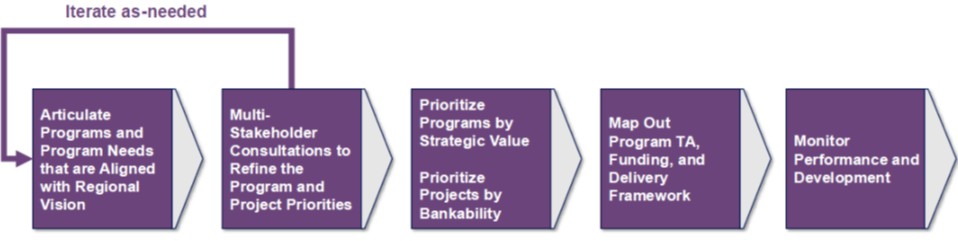
The analytical groundwork has been laid, political interest is evident, and a growing pipeline of projects is taking shape. The task ahead is to convert this momentum into tangible results by focusing on coordination, prioritization, quality and streamlined execution.
For policymakers, this means prioritizing reforms and investments that deliver regional and national value while mitigating risks that deter private investment at scale. For MDBs, it means supporting aligned investment programs and associated regulatory frameworks that crowd in capital and strengthen institutions. For investors, it means recognizing that Central Asia is transitioning from a frontier market to a region where structured and scalable opportunities are increasingly available.
Together with our partners, AIIB is committed to building a more interconnected and prosperous future for Central Asia, where connectivity infrastructure is not just a foundation for growth but a bridge to shared success.