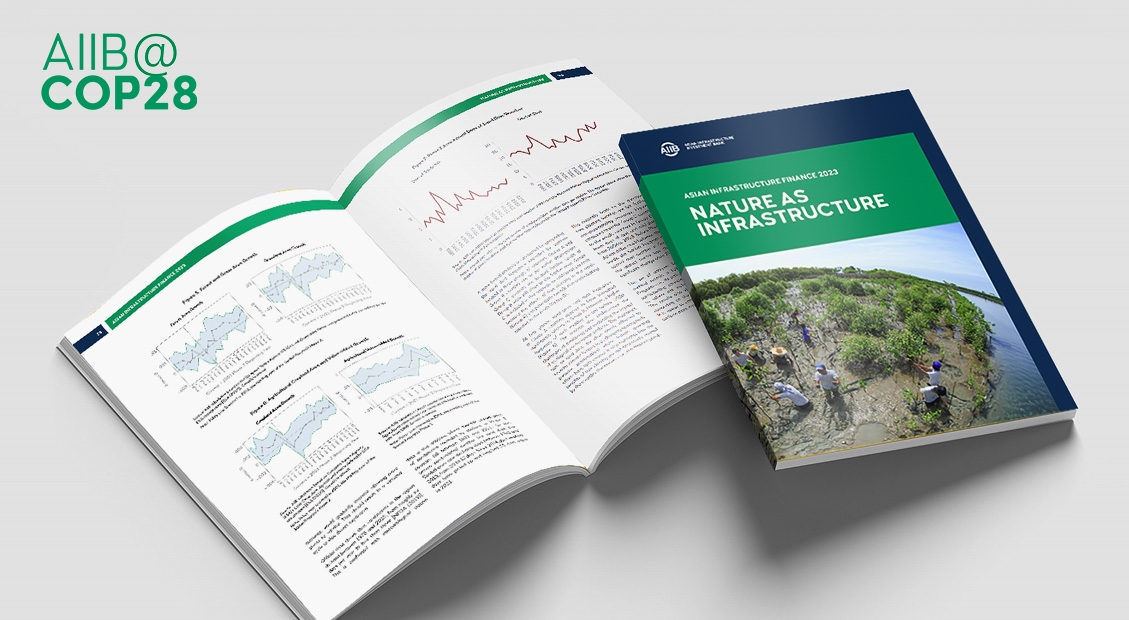

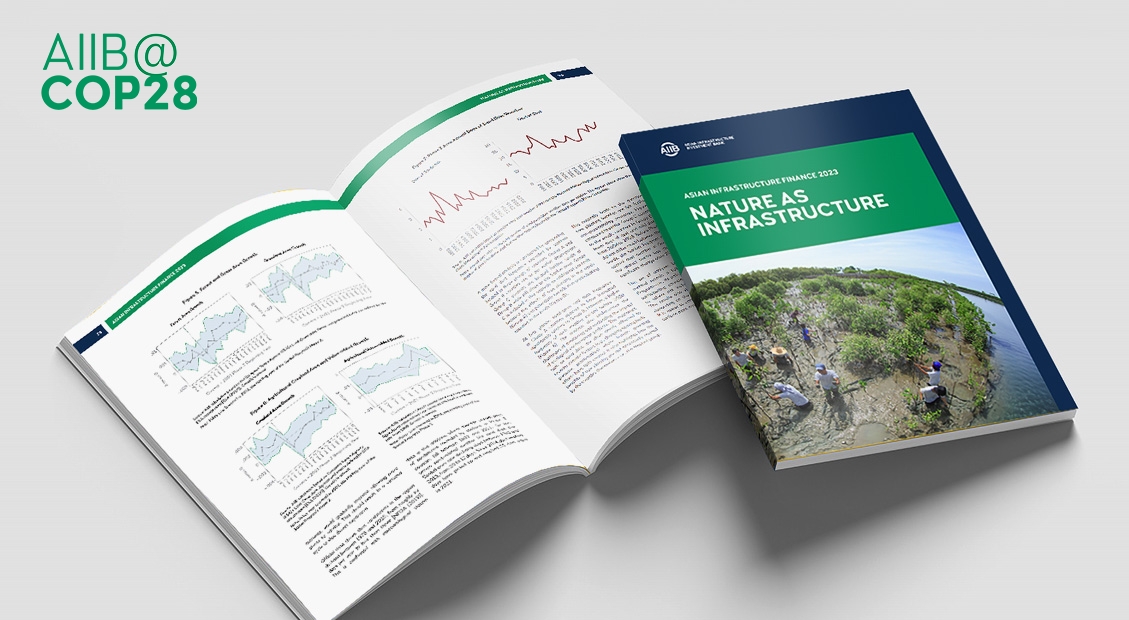
The Asian Infrastructure Investment Bank (AIIB) today launched its 2023 Asian Infrastructure Finance report, titled Nature as Infrastructure, with a panel discussion at its COP28 pavilion.
Amid accelerating climate change, the increasing value of carbon capture and the ongoing degradation of biodiversity globally, the concept of Nature as Infrastructure arrives at a pivotal moment. Viewing Nature as Infrastructure offers a transformative approach for recognizing the value of nature and enhancing investment in the protection of nature and biodiversity.
“It is high time for us to come to terms with nature; we cannot keep asking for more,” said AIIB President and Chair of Board of Directors Jin Liqun. “This process of reconciliation must begin by understanding and recognizing the value that nature can offer us. Our ambition must be to turn the idea of nature as infrastructure from an abstract concept into an impactful asset class that commands increasing levels of investment and regulatory attention.”
Viewing Nature as Infrastructure entails mitigating the impact of human development on nature. It includes nature-based solutions, direct investments into nature assets to sustain critical infrastructure-like services and directing more finance toward nature. Potential solutions toward a nature-positive future were discussed during the panel and is explored further in AIIB’s 2023 Asian Infrastructure Finance Report: “Nature as Infrastructure.”
Following AIIB President Jin's opening remarks, the panel was moderated by Devex Executive Vice President and Executive Editor Kate Warren, and joined by industry-leading commentators from across the world, including Erik Berglof, Chief Economist, AIIB; Jang Ping Thia, Lead Economist, AIIB; Simon Zadek, Executive Director, NatureFinance; Institute for Climate and Society Executive Director Maria Netto Schneider; Valerie Hickey, World Bank Global Director for Environment, Natural Resources and Blue Economy and Rebekah Brown, Deputy Vice-Chancellor, Research, Monash University.
“MDBs must work to close the financing gap to adopt a more nature-friendly development path and reverse biodiversity loss,” said Erik Berglof, Chief Economist of AIIB. “We must go beyond ‘do no harm’ and even beyond ‘nature-positive’ investment and look at how we can draw on the full potential of nature. This means unlocking fresh financing from our balance sheets, deploying new lending instruments and using our convening power to better mobilize private finance.”
Incorporating nature into investments is already a key priority for AIIB and the report supports the existing strategy at the Bank. During the AIIB’s 8th Annual Meeting in September 2023, AIIB unveiled its inaugural Climate Action Plan (CAP), which set out the Bank’s ongoing commitment to combatting climate change through four key principles. As part of the CAP, AIIB signaled its intention to focus on solutions that simultaneously mitigate climate change, build resilience, enhance adaptation and offer cobenefits for biodiversity and nature conservation. Viewing nature as infrastructure and integrating nature-based solutions into infrastructure design will enhance climate resilience.
Drawing on extensive data and case studies from all over the world, the report points to opportunities to maximize nature as our most critical infrastructure. Building on the basic understanding that there is a need to understand the value of nature—as well as how the economy of countries and sectors depends on nature—the report goes on to discuss how nature can provide infrastructure-like services, which in turn should influence how gray infrastructure and investments in nature’s restoration are made.
It shares examples of how better design can mitigate the impact of gray infrastructure and help people build greener infrastructure. In particular, the report looks at how China, Indonesia and Bangladesh adopted nature-based solutions to restore or renew nature. For example, tree planting in the northern countries of China was found to have a beneficial impact on dust conditions for countries further south without compromising agricultural productivity, mangrove planting in Indonesia was found to reduce losses from tidal floods and the wetlands of Bangladesh support critical primary industries and livelihoods.
All these examples demonstrate the importance of testing the best solutions customized to the local environment. Successfully and sustainably harnessing nature as infrastructure requires scientific research, effective implementation, consultation and engagement with local communities and a combination of policy incentives, including short-term fiscal support and commercial investments. The report also applies these tools to value natural capital in the Bank’s own projects.
The report also explores how various financial tools instruments can be used to channel more financial flows to nature and build on nature as infrastructure as an asset class. The report notes that there is a particular need to assist low-income economies, many of which are adversely affected by climate-related disasters, and how multilateral development banks like AIIB can catalyze efforts to mainstream nature into all development considerations.
Putting nature, people, lives and livelihoods at the heart of climate action is a key thematic priority at COP28. AIIB and the COP28 Presidency are collaborating to mobilize much-needed climate investment capital and accelerate clean energy investments to address critical resource gaps in Asia and beyond.
The report can be read in full on AIIB’s website here.
About AIIB
The Asian Infrastructure Investment Bank (AIIB) is a multilateral development bank whose mission is financing the Infrastructure for Tomorrow—infrastructure with sustainability at its core. We began operations in Beijing in January 2016 and have since grown to 109 approved members worldwide. We are capitalized at USD100 billion and Triple-A-rated by the major international credit rating agencies. Collaborating with partners, AIIB meets clients’ needs by unlocking new capital and investing in infrastructure that is green, technology-enabled and promotes regional connectivity.